

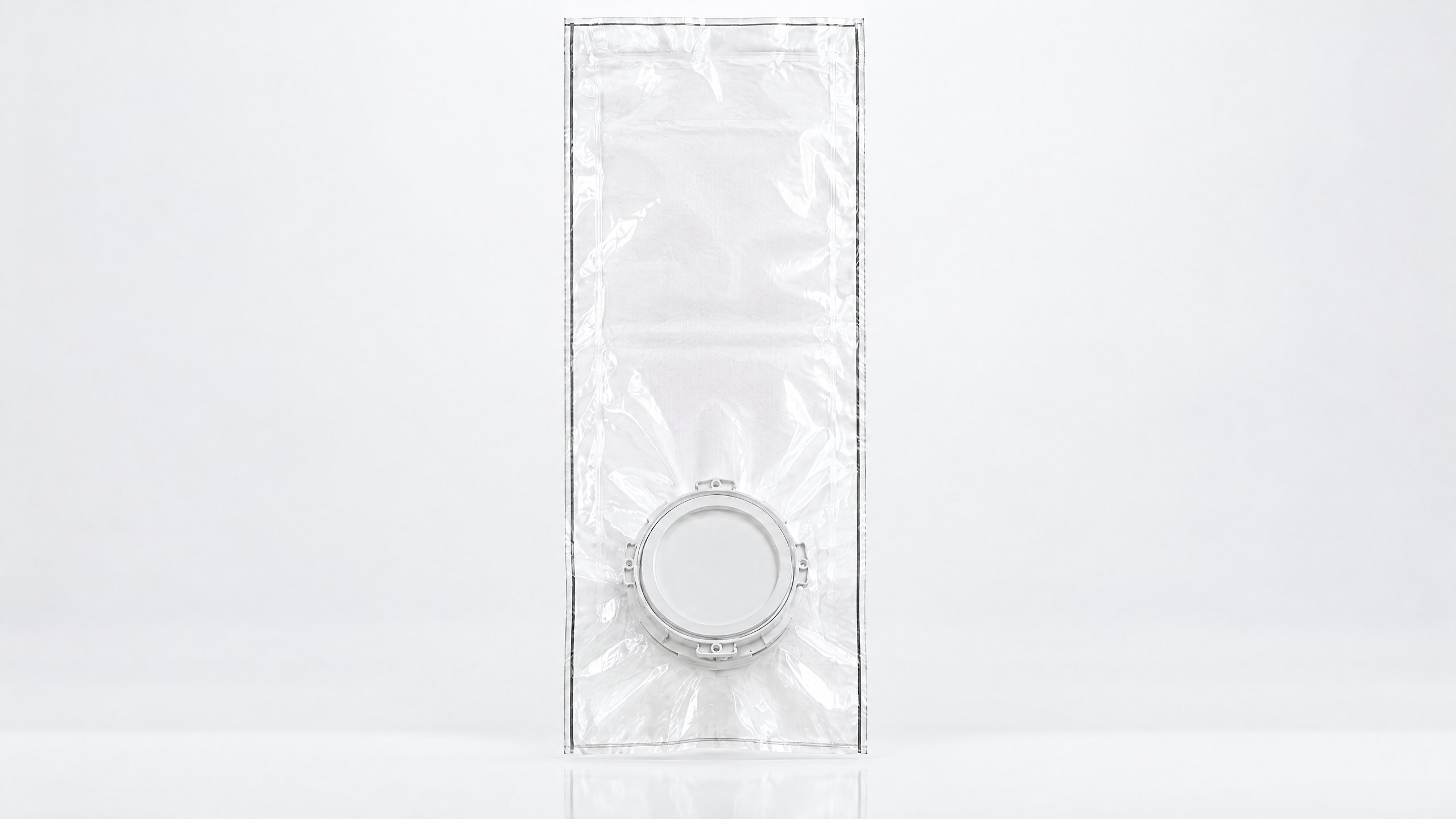
A single-use RTP bag is a beta bag: "beta bag", "RTP bag" and "rapid transfer port bag" all name the same transfer item, the disposable half of a rapid transfer port that docks to the alpha port mounted on an isolator, a RABS or a filling line. DeltaQuant Lifesciences FZE makes that item as the DELTAQUANT 190 mm single-use beta bag, for industry-standard 190 mm alpha ports, in two product lines and two varieties, and this page sets out what it is, how the lines and varieties differ, how the flange fits the port, and which documents come with it. Everything here is also on the Products page; this page exists for the people who search by the other names.
What an RTP bag is
A rapid transfer port has two halves. The alpha port is the fixed half, mounted in the wall of the isolator or RABS, with its own door. The beta half is the container that docks to it: a rigid beta container that is cleaned and reused, or a single-use beta bag that arrives loaded, docks once or a few times, and is discarded. The DELTAQUANT bag is the single-use beta half. It is a flat pouch, two faces welded together around the edge: a clear, impervious multilayer LLDPE face and a white Tyvek® flash-spun HDPE face that breathes but holds a microbial barrier (ASTM F1608, acceptance criterion LRV ≥ 4). The rigid beta flange, high-temperature polycarbonate with a platinum-cured silicone beta seal and O-ring and an HDPE weld ring, is sandwiched into the pouch face at its lower middle; a removable stainless-steel pull handle is optional and does not touch the contents.
Docking is the same for every rapid transfer port of this type. The flange cover meets the alpha door, a short turn locks the bag to the port, and the two doors open together as one plate so that neither outer face is ever exposed to the inside of the barrier. The contents pass through, the plate closes, the bag turns back and comes away with its cover re-sealed. The bag is rated for up to 5 dockings, so a part-emptied bag can be removed and docked again later. It is supplied in a double-bag configuration, each bag overwrapped and tamper-evident sealed, and the carton carries the lot, the configuration, the dates and a QR-coded GTIN. Store it at 13–27 °C and 30–60 % RH, away from sunlight, ozone and heat.
Empty or Pre-loaded
Both product lines are the same bag; they differ in who fills it.
- Empty beta bags. A ready-to-use RTP bag that your own team loads in your own process: stoppers, tools, sampling equipment, product containers, waste. Available in every variety, volume and port option. The usual choice where a site already has a validated route for preparing its components and wants the bag as the last step.
- Pre-loaded beta bags. You send us the components, we load them into the bag in our ISO Class 7 cleanroom, and the bag arrives ready to dock. The components can be rubber stoppers, twist-off ports, aluminium seals and flip-off caps, plungers, or other components you supply or we source. Units per bag, the sterilisation route of the loaded kit and its validation are agreed per kit with you; we publish no fill count and no sterilisation claim for a kit, because both depend on your component and your process.
Which line fits a given transfer is worked through on the application pages, from aseptic fill-finish and vial, syringe and stopper loading to aseptic waste removal.
indA or indB
The variety is the sterilisation route of the bag itself.
- indA, autoclavable. Supplied non-sterile and autoclaved by the customer in one validated cycle at 121 °C for 30 min, with a steam indicator dot (ISO 11140-1 Class 1) on the bag and a shelf life of 3 years from manufacture. For sites that autoclave their closures in-house and want the bag to go through the same cycle.
- indB, gamma sterile. Supplied pre-sterilised by gamma irradiation at 25–40 kGy to a sterility assurance level of 10⁻⁶, with dosimetric release per batch and a shelf life of 2 years from manufacture. For sites with no autoclave in the suite, and for pre-loaded kits that should dock and go.
Both varieties exist in both volumes, 10 L and 25 L, and custom sizes are made on request after an engineering review. The guide Autoclave vs gamma: choosing a beta bag goes through the decision in detail, and Beta bag shelf life explained covers the dates.
Port compatibility: Standard and Interlock-chamfer
The flange is made to Ø 190 ± 0.4 mm and is compatible with industry-standard 190 mm alpha ports. It comes in two versions: the Standard flange for standard 190 mm alpha ports, and the Interlock-chamfer (IC) version for chamfered alpha ports. To confirm the fit, send us the alpha port model fitted to your isolator or RABS and whether its door is standard or chamfered; engineering confirms the version, and samples let you dock on your own port before you order. What to look at on the port is set out in 190 mm alpha port compatibility: what to check, and the number of dockings a bag takes in How many dockings can a beta bag take.
Documents with every batch, and on request
Every batch ships with a CoA and a CoC. Behind them is release testing on every bag and every batch: a 100 % flange leak test by pressure decay (5 in. H₂O over 60 s), 100 % visual inspection, dimensional inspection at AQL 0.65, and per-batch testing of bioburden (≤ 1000 CFU/bag, ISO 11737-1), endotoxin (< 0.25 EU/mL, USP <85>), particulates (USP <788>) and weld strength. The product-contact materials are covered by USP <87> / <88> Class VI, ISO 10993-1, FDA 21 CFR 177.1580 / 177.2600 / 177.1520, BSE/TSE (EMA/410/01), REACH / RoHS and Ph. Eur. 3.1.5, and the risk management follows ICH Q9 and ISO 14971.
On request we provide the autoclave compatibility statement and the post-autoclave inspection protocol for indA, load-pattern guidance, an extractables summary and the validation package under MNDA. The method and the acceptance criterion of every type test, alpha-port docking, multi-cycle docking, cover removal force, weld peel strength (ASTM F88), burst (ASTM F1140), seal dye penetration (ASTM F1929), film tensile and elongation (ASTM D882), the microbial barrier (ASTM F1608), transit (ASTM D4169), steam compatibility, gamma compatibility and the sterility audit, are listed on the Proof & Documents page, where each document has its own request link. A measured value is published only when a batch report carries it.
Request samples
Build the configuration in Build Your Bag: line, variety, volume and flange version, with the useful volume and the shelf life shown as you go. Then request samples to dock on your own alpha port, or ask for a quotation; sales replies within one business day. No prices are published, because a quotation depends on the configuration and the quantity.