

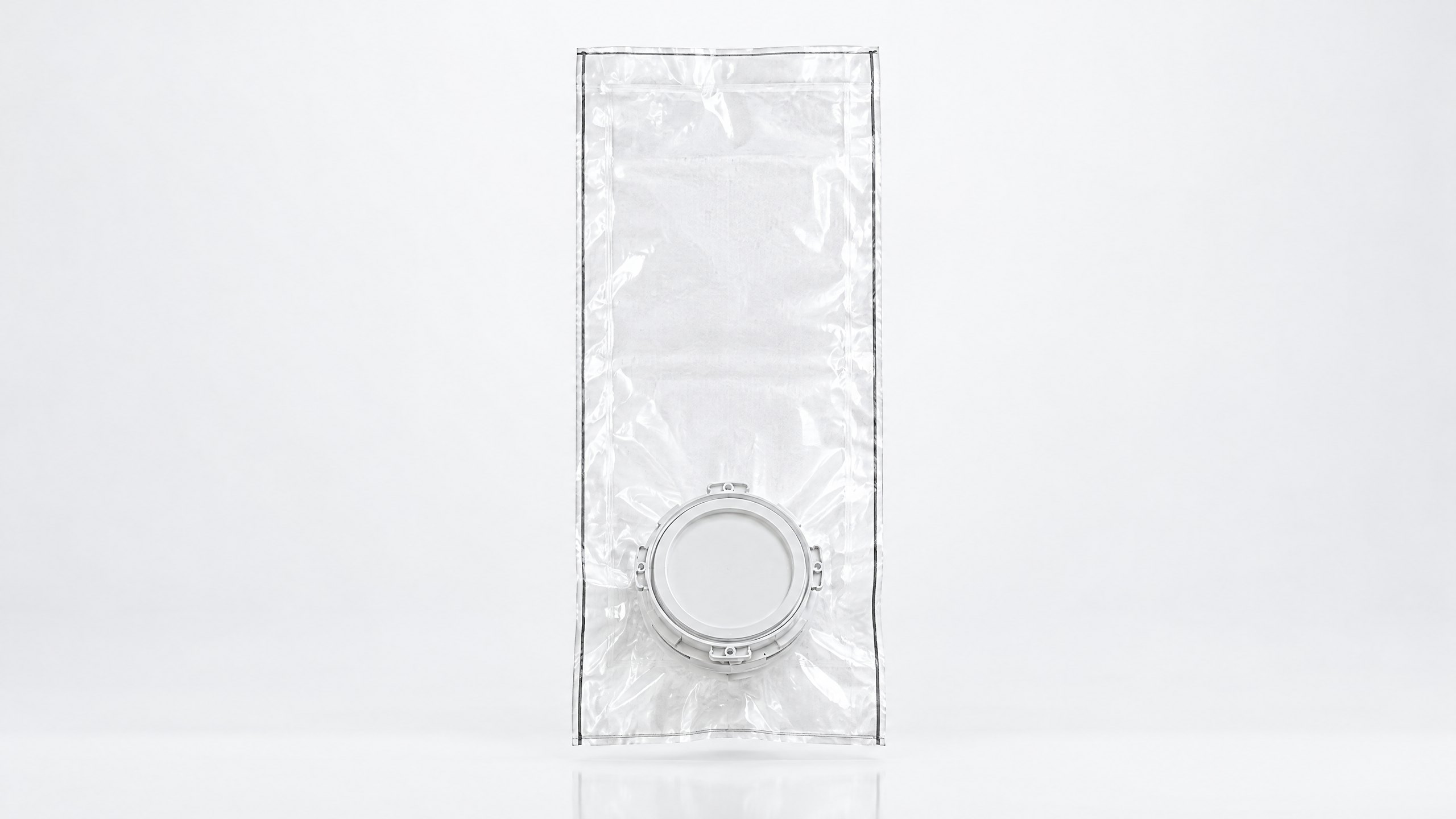
An isolator transfer bag is a single-use beta bag: the disposable container that docks to the 190 mm alpha port in the wall of an isolator or a RABS and lets components, tools, samples and waste cross the sterile boundary without a door opening or a decontamination cycle. DeltaQuant Lifesciences FZE makes it as the DELTAQUANT 190 mm single-use beta bag, for industry-standard 190 mm alpha ports, as an Empty bag your team loads or a Pre-loaded bag we load in our ISO Class 7 cleanroom. This page is written around the isolator: what goes in, what comes out, and which configuration suits each movement.
Why the alpha port, not the hatch
An isolator holds its critical zone sealed and decontaminated; a RABS holds it behind a rigid wall and a strict door regime. In both, every material movement is the moment the barrier is at risk, and the alpha port is the way to make that movement a closed one. The alpha port is the fixed half of a rapid transfer port, with its own door. The beta bag is the single-use half: its flange cover meets the alpha door, a short turn locks the bag to the port, and the two doors open together as one plate, so that the outer faces of both are never exposed to the inside. Compared with a transfer hatch, nothing waits in a chamber between steps and no cycle time is spent; compared with a door opening, nothing is recorded as an intervention.
The DELTAQUANT bag is a flat pouch with the rigid beta flange sandwiched into its face at the lower middle. One face is a clear, impervious multilayer LLDPE film; the other is a white Tyvek® flash-spun HDPE microbial barrier that lets steam and gas through and holds a microbial barrier (ASTM F1608, acceptance criterion LRV ≥ 4). The flange is high-temperature polycarbonate with a platinum-cured silicone beta seal and O-ring and an HDPE weld ring, made to Ø 190 ± 0.4 mm, in a Standard version and an Interlock-chamfer (IC) version for chamfered alpha ports. The bag is rated for up to 5 dockings.
Components in
Closures are the daily case: rubber stoppers for a filling isolator, aluminium seals and flip-off caps for a capping station, plungers for a syringe line, twist-off ports for a bag line. They arrive from the maker in bulk packaging that was never meant to cross a barrier, so someone repacks, sterilises and documents them before every transfer. The Pre-loaded line takes that work out of the suite: you send us the components, we load them into the bag in our ISO Class 7 cleanroom, and the bag arrives ready to dock. Units per bag, the sterilisation route of the loaded kit and its validation are agreed per kit with you; we publish no fill count and no sterilisation claim for a kit. The application pages work through the cases: aseptic fill-finish, vial, syringe and stopper loading, components into RABS and, for the makers of the components themselves, component makers.
Tools, samples and product in
Not everything that enters is a closure. Tools for a format change, sampling equipment, environmental-monitoring plates, lyophilisation trays and containers of sterile API powder all have to cross the same boundary. The Empty line is made for that: a ready-to-use bag your own team loads in your own process, available in every variety, volume and port option, with the useful volume and the flange shown as you configure it. The reasoning per case is on sterile API powder, lyophilisation trays, environmental monitoring and sampling and cleanroom staging.
Waste out
The transfer runs both ways. Used closures, wrappings, spent monitoring plates and other waste leave the isolator through the same port in an Empty bag docked from inside: the plate opens, the waste goes into the pouch, the plate closes, and the bag comes away sealed with its contents contained, ready for disposal without ever having been open to the room. The case is set out on aseptic waste removal. Because the bag takes up to 5 dockings, a waste bag can be docked, part-filled, removed and docked again across a shift.
Which variety and which volume
The variety is the sterilisation route of the bag itself. indA is supplied non-sterile and autoclaved by the customer in one validated cycle at 121 °C for 30 min, with a 3-year shelf life; it suits sites that autoclave their closures in-house. indB is supplied gamma sterile at 25–40 kGy to SAL 10⁻⁶ with dosimetric release per batch and a 2-year shelf life; it suits sites with no autoclave in the suite and kits that should dock and go. The volume is the pouch: 10 L handles well flat against a wall at glove height, 25 L suits long campaigns and bulk closures, and custom sizes are made on request after an engineering review. The guide Autoclave vs gamma: choosing a beta bag goes through the choice.
What travels with the bag
Every batch ships with a CoA and a CoC. Every bag has a flange leak test by pressure decay (5 in. H₂O over 60 s) and a visual inspection; every batch is tested for bioburden (≤ 1000 CFU/bag, ISO 11737-1), endotoxin (< 0.25 EU/mL, USP <85>), particulates (USP <788>) and weld strength, with dimensional inspection at AQL 0.65. The product-contact materials are covered by USP <87> / <88> Class VI, ISO 10993-1, FDA 21 CFR 177.1580 / 177.2600 / 177.1520, BSE/TSE (EMA/410/01), REACH / RoHS and Ph. Eur. 3.1.5; risk management follows ICH Q9 and ISO 14971. The bag is supplied in a double-bag configuration, overwrapped and tamper-evident sealed, with the lot, the configuration, the dates and a QR-coded GTIN on the carton; store it at 13–27 °C and 30–60 % RH. On request: the autoclave compatibility statement and post-autoclave inspection protocol for indA, load-pattern guidance, an extractables summary and the validation package under MNDA. Every method and acceptance criterion is on the Proof & Documents page.
Request samples
Send us the alpha port model fitted to your isolator or RABS and whether its door is standard or chamfered, and engineering confirms the flange version. Build the configuration in Build Your Bag, then request samples to dock on your own port; sales replies within one business day. The same bag is described by its other name on Single-use RTP bags and in full on Products.